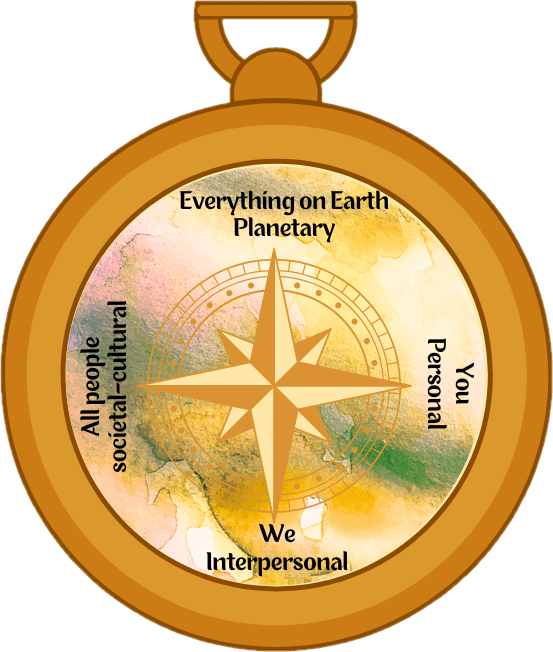
What does it take to build real peace? The Peace Compass offers a four-level framework, and a practical starting point for readers anywhere in the world.
by Nina Koevoets | 29 June 2026
“Peace is not the absence of conflict, but the presence of solutions.” – Dorothy Thompson, American journalist (1893 – 1961)
This is the quote with which I start my book The Peace Compass. I started writing this book in February 2024, urged by the atrocities in the Occupied Palestinian Territory of the Gaza Strip following Hamas’ attack on Israel on October 7, 2023. I imagined the anguish of parents trying to shield their children from bombings, only to find that even “safe zones” and hospitals were targeted. I thought of the trauma of Palestinians reliving the Nakba of 1948 when their homes were destroyed or taken and the heartbreak of Israeli families whose loved ones were taken hostage or killed in the brutal attack. I wondered how the people were doing that I once knew from the time that I lived in Jerusalem and Bethlehem over a decade ago. Like many others, I felt helpless — a spectator to events that seemed beyond my control. It left me wondering: what can any of us do in the face of such devastation? I try to answer that question with this book.
The last years, 2021-23, have been the most violent since the end of the Cold War in 1989, according to the Peace Research Institute Oslo. 2023 had the highest number of state-based conflict since 1946, the year marking the end of World War II. Israel was by far the most injurious actor in 2023: they were responsible for 60% of all reported civilian fatalities worldwide, according to Action on Armed Violence. This unprecedented escalation demands we take a stand for peace.
Peace activist Vivian Silver, killed during the attack of Hamas, said that peace is the only way to resolve the decades-long conflict. “The attack on October 7 was cruel and really brutal. But it happened in a certain context of this region of years and years of dehumanization of people from both sides,” her son declared, speaking to CTV News in November 2023. He continued with saying that “if enough people want peace, then we will eventually have it,” but personally, I believe that in addition to wanting peace, people have to be able to do it. They must be emotionally ready for it, rationally understand that violence never brings peace and know what does contribute to peace, and how they themselves can play a role in it. So, I hope that readers will not only want peace after finishing this book, but also feel empowered to actively choose it.
My book cannot immediately change political realities, but it offers a vision for peace that we can immediately start to work on, to create long-term and long-lasting change. The examples given in the book are from all over the world, so that readers everywhere can find things that may be relevant for them. The Peace Compass provides both a frame-work and practical tools to empower readers to take small yet meaningful steps toward peace, no matter where they are in the world. The more people understand how to build peace, the faster we can all experience a more compassionate and wholesome life.
Now let’s get back to the quote: many people view peace as the absence of war or armed struggle, which leaves us wondering what must be present to live in peace. Johan Galtung, one of the founders of peace science, called this negative peace and coined its opposite: “positive peace”. Positive peace is the presence of a set of beliefs, attitudes and structures that promote peace.
The Institute for Economics and Peace, established in 2007, created a Peace Index inspired by the concept of positive peace, a measurement of peace in all the different countries in the world. While it’s informative to get a global picture, my preference is for another concept inspired by positive peace: a culture of peace, because the focus is less on economics. The concept was first proposed by UNESCO and later adopted by the UN. In 1999, they drafted a declaration and Program of Action on a Culture of Peace (A/RES/53/243). In it, they defined this concept as follows:
“A culture of peace comprises a set of values, attitudes, modes of behavior and ways of life that reject violence and prevent conflict by addressing its root causes and solving problems, through dialog and negotiation among individual groups and countries.”
While values and attitudes pertain to the individual, and are “micro level” peacebuilding, the areas mostly deal with the structures, or institutions, in our society that promote peace, the second part of the definition of positive peace, and are thus more “macro level” peacebuilding.