
Discover 24 types of peacebuilders across 9 categories. Find your peacebuilding superpower using this comprehensive typology.
by Taylor O’Connor | 8 March 2026
How and Why this Framework was Developed
Why I created this typology
When I was in college in California when the US invaded Iraq and the wider ‘global war on terror’ began. I joined student groups participating in protests against the war and while it sparked in me an interest in nonviolence strategy, I became curious to explore other ways to build peace beyond activism. Soon later I got my Masters in Peace Education, then worked for some years on peacebuilding projects in many countries with grassroots groups, national and international organizations, and UN agencies.
While my horizons expanded, I still found that peacebuilding activities conducted within the aid industry (where most formal peacebuilding activities operate) follow predictable patterns, conforming to a limited scope of set project types dictated by funding mechanisms and political decision-makers. I continued searching for other ways to build peace, both inside and outside of formal systems, that could more effectively transform the causes of war and violent conflict.
This led me to over a decade of researching peace practice, culminating in the publication of this comprehensive peacebuilder typology mapping 24 types of peacebuilders across 9 categories. Included in each type I map a range of approaches taken to build peace in hopes to expand how with think of peacebuilding and supporting a wide range of experienced and aspiring peacebuilders to find creative and effective ways to build peace.
In this article
This article is organized into 6 main categories, with detailed breakdowns of approaches to build peace within each of the 24 Peacebuilder Types:
- How and Why this Framework was Developed
- How to Use This Typology
- Overview of the Peacebuilder Typology
- Detailed, Clickable Table of Contents
- The 24 Peacebuilder Types
- Use this Typology to Strengthen your Peace Efforts
You can download the full Typology via the form below:
How I created this typology
10+ Years Researching Peace Practice
In 2015, while working as a peacebuilding consultant, I began spending my free time researching peacebuilding practice. I searched for all the ways people build peace inside and outside traditional systems. I began to notice patterns. I tracked networks and documented what I found. Over time, I built a database of 5,000+ organizations working for peace worldwide.
I started categorizing organizations by the approaches they took, be they peace education, activism, arts, environmental peacebuilding, technology, or others. And I documented hundreds of approaches to building peace. I also saw how those of us who work for peace in different ways often work in silos, and felt that if we could learn of all the different ways we could build peace it would make our peace efforts more creative and effective.
Evolution of this typology 2020 – 2026 + new data sources
The first version of this typology I called 198 Actions for Peace, which I used to promote the launch of Everyday Peacebuilding in January 2020. I began to publish blog posts bit by bit mapping organizations within each category to share what I knew, making this information more practical and accessible to anyone interested to build peace. Community member Mustapha Ali joined in 2024 to support data processing and categorization, accelerating our ability to publish content on the website mapping organizations topic by topic that could eventually cover the entire database.
In 2025 we started using LLMs to help process data within each category to map and categorize different approaches to peacebuilding. We had the data from my organization database and also started to cross-reference each category using insights from another database I built with responses to surveys from 800+ community members which provided insights on ways peacebuilders from all walks of life build peace in over 100 countries.
Years of data analysis and categorization from my database of 5,000+ peace organizations and data from 800+ community surveys form the basis of this peacebuilder typology.
How this Typology is Unique from Other Peacebuilding Frameworks
As this typology was coming together I checked other existing frameworks to see if there was anything missing. I reviewed John Paul Lederach and Katie Mansfield’s Strategic Peacebuilding Pathways, Lederach’s Actors and Approaches to Peacebuilding, Lisa Schirch’s framework in her book The Little Book of Strategic Peacebuilding, and The eight Pillars of Positive Peace by the Institute for Economics and Peace, among others. I also drew inspiration from CDA Collaborative Learning’s Reflecting on Peace Practice (RPP) and resources on approaches for conflict transformation by Berghof Foundation.
I found no gaps this typology doesn’t address, but I did find it to be more comprehensive than any existing framework. Additionally, it fills common gaps that can be found in frameworks in the following ways:
- It included approaches beyond the peacebuilding sector: My 10+ years of research focused on mapping approaches to building peace both within traditional systems and institutions, and outside of these, covering approaches often missed by other frameworks that focus on established peacebuilding activities within traditional systems. It includes peacebuilding approaches found within the peacebuilding sector and many that are not part of traditional peacebuilding, though they contribute to building peace.
- It integrates key approaches of Everyday Peacebuilding (demilitarist, decolonial and intersectional peacebuilding): Traditional peacebuilding systems create barriers for peacebuilding initiatives operating within them to tangibly address militarization and colonization, and they take a very soft, often hands off approach to social justice issues. Each peacebuilder type in this typology includes ways to build peace that include traditional approaches as well as approaches associated with demilitarization and decolonization, and I have made strides to map practical linkages for how specific social justice efforts can contribute to peace.
How to Use This Typology
This version of my peacebuilder typology is the first full and comprehensive version I have produced since completing processing of my key data points (5,000+ organizations and 800+ community surveys). I think it is in a solid place to use in a variety of applications for individuals and organizations.
For Individuals: Discover your peacebuilding superpower
Individuals can review this blog post or download it:
You should try to work out your top 3 interest areas, learn about them and get connected to organizations and resources associated with them. Recognizing that these are the areas of your strength, you can reflect on how you can utilize your unique combination of strengths to make change on the social issue you care about as relevant to your context.
It isn’t just finding the type that is right for you. In reality, we all have strengths in multiple areas. Consider the interlinkages between your top three types.
For example:
- Peace Educators (Type 10) can develop curriculum and programming on areas of their interest like environmental peacebuilding, peace economics, societal healing, or counter-recruitment.
- If you’re an Artist, Convener, and Psychosocial Healer (Types 8, 12, 17), you could convene group art activities for healing in conflict-affected communities.
- A Peace Researcher, Media Content Creator, and Activist (Types 21, 9, 1) could document peace movements while producing compelling social media content that draw on lessons from the past and mobilize effective nonviolent peace action.
When you figure out how your unique combination works, consider this your peacebuilding superpower.
For some, particularly students, early-career professionals and those changing career trajectories, you may additionally discover new career pathways you may want to explore that you can use to build peace.
For Organizations: Plan creative and effective peace initiatives
Organizations can use this typology to discover creative project ideas, develop innovative initiatives, or create multi-approach strategies. Networks, coalitions and those working informally to build peace can do the same. Rather than defaulting to traditional approaches found commonly across peacebuilding ecosystems, you can identify which combination of types (and approaches within them) are most appropriate to transform the causes of conflict in your context.
Be sure to download it and share it with your team:
Navigating the Typology
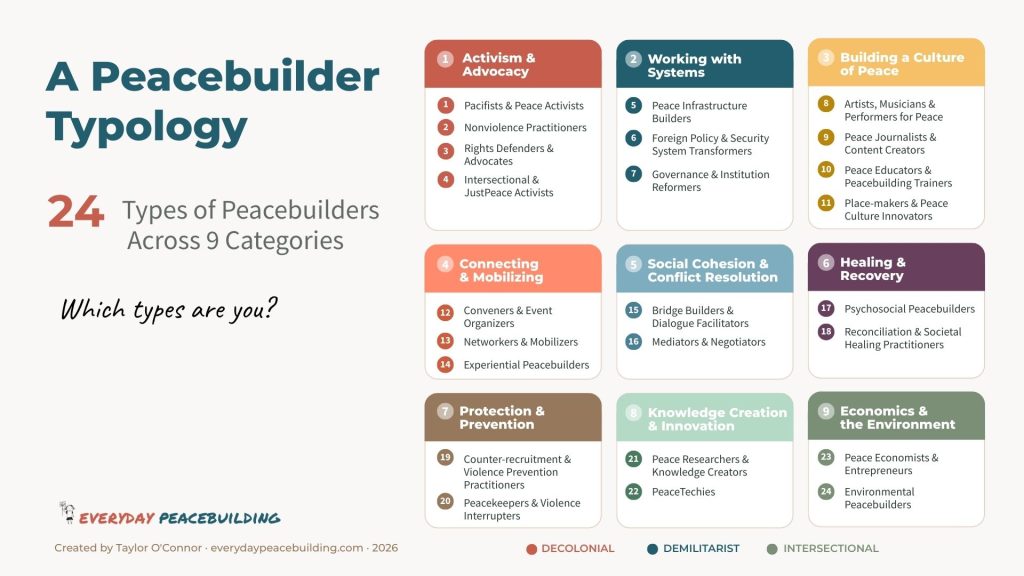
Below you’ll find an Overview of the Peacebuilder Typology organizing all 24 types across 9 categories. Skim this overview to identify areas of interest, then use the clickable Table of Contents below it to navigate to detailed descriptions and approaches within specific types.
Overview of Categories and Types of Peacebuilders in This Typology
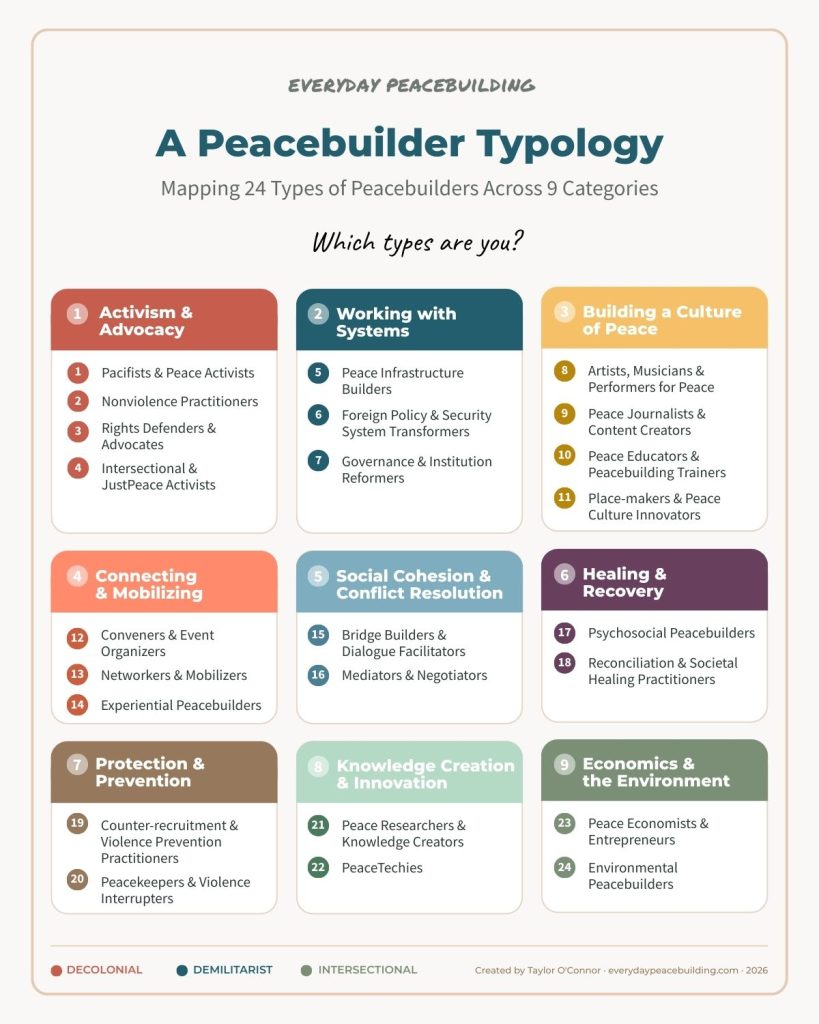
CATEGORY 1: Activism and Advocacy: This category includes peacebuilders who challenge systems of war, militarism, violence and injustice through nonviolent direct action, organizing, and advocacy. They typically work outside of formal institutions they seek to change. Peacebuilder types in this category include:
- Type 1. Pacifists & Peace Activists: Includes anti-war activists and those using nonviolent resistance methods to challenge war profiteers, nuclear disarmament and demilitarization advocates, conscientious objectors and those who support them, war tax resisters and veteran peace activists.
- Type 2. Nonviolence Practitioners: Includes nonviolence practitioners conducting research on nonviolent movement history and documentation of tactics and strategies, also those conducting nonviolent tactic and strategies trainings (for peace activists and peacebuilders), those involved in nonviolent direct action and creative resistance in peace movements and involved in nonviolent resistance to authoritarianism and state violence.
- Type 3. Rights Defenders & Advocates: Includes practitioners investigating human rights violations and using their reports to advocate to end violations, also genocide and atrocity prevention advocates, those advocating for accountability for state and political violence, and rights education and community mobilization; also those protecting rights of migrants, refugees, minority and marginalized populations.
- Type 4. Intersectional & JustPeace Activists: This is social justice activists linking their cause to peace, war or demilitarization; includes those transforming gender norms associated with war and violence, racial/immigrant justice activists advocating to demilitarizing police, prisons, immigration systems and borders; also anti-imperial and anti-colonial resistance and solidarity, challenging military occupation/use of indigenous lands, and applying feminist thought and intersectional approaches to peace/justice efforts.
CATEGORY 2: Working with Systems: This category includes peacebuilders working to transform political, government, economic, UN/international, multilateral and security systems and institutions predominantly working within or adjacent to the systems and institutions they seek to change. Also includes those engaging in policymaking against war/militarism and for peace, as well as those building peace infrastructure. Peacebuilder types in this category include:
- Type 5. Peace Infrastructure Builders: Includes those involved in UN peace architecture and multilateral institutions involved in promoting peace and security, also advocating for systems change to barriers in these systems and those working to promote the humanitarian-development-peace nexus in international aid projects; also includes those building formal and informal peace infrastructure at local, national, regional and global levels as well as those promoting inclusion of diverse and marginalized voices in peace processes, systems, platforms and structures.
- Type 6. Foreign Policy & Security System Transformers: This type is individuals working INSIDE systems and institutions to transform foreign policy and security systems, mostly at the national level; includes those working to demilitarize foreign policy and promote diplomacy, and those working to demilitarize defense/security budgets, institutions and affiliates; also includes whistleblowers who expose military/defense/security sector wrongdoing as well as those working in mutual disarmament and arms-control in ways that don’t perpetuate domination and control of powerful countries.
- Type 7. Governance & Institution Reformers: This type includes government officials and civil servants of all types working INSIDE democratic governance, justice, and public institutions to reform them toward peace and demilitarization; Includes anti-corruption, transparency and accountability of institutions profiting from war/militarization, and demilitarization of law enforcement, prisons, immigration systems, universities, businesses and institutions; also promotion and use of restorative/transformative justice practices, representation to shift power dynamics in governance and decision making, promotion of contextually-appropriate and non-western democratic models, among other approaches.
CATEGORY 3: Building a Culture of Peace: This category includes a wide range of peacebuilders that seek to influence culture and transform public perception, transforming cultures of war and violence to cultures of peace. It includes work in the area of peacebuilding and the arts, peace journalism and peace media, peace education, those creating spaces and places of peace, and those who take innovative approaches for transforming elements of culture. Peacebuilder types in this category include:
- Type 8. Artists, Musicians & Performers for Peace: Includes many types of artists, musicians and performers taking a range of approaches to build peace, including craftivism, public art, theater of the oppressed and other applied performance methodologies, photographers, spoken word artists, dancers, comedians and circus arts performers.
- Type 9. Peace Journalists & Content Creators: Includes peace journalists and peace media producers, radio and podcasters for peace, social media content creators, film/TV and documentary production for peace, also strategic communication, peace messaging, and peace storytelling and public speaking.
- Type 10. Peace Educators & Peacebuilding Trainers: Includes primary and secondary level teachers that use curriculum/activities in peace education or related themes, university level peace and conflict studies professors, peacebuilding trainers, educators working in conflict-affected contexts, school administrators and education policymakers, nonformal education practitioners, curriculum developers, and others.
- Type 11. Place-makers & Peace Culture Innovators: Includes peace architects, urban planners and peaceful city initiatives, also zones of peace, safe spaces and sanctuaries, also peace museums, exhibits and peace history curation, also peace landmarks, monuments and gardens, and also those who use peace symbols, rituals, prizes and innovative use of cultural practices.
CATEGORY 4: Connecting and Mobilizing: This category includes peacebuilders bringing people together through physical and virtual events, networking and coalition building, and a range of experiential methods to to strengthen peace efforts, build relationships or mobilize action for peace. Peacebuilder types in this category include:
- Type 12. Conveners & Event Organizers: Includes those who plan conferences and gatherings on topics related to peace, also festivals and cultural gatherings, workshops and dialogue/discussion series, webinars and virtual events.
- Type 13. Networkers & Mobilizers: Includes those who build networks and coalitions for peace action, also peace resource centers and physical hubs, also platform coordination, community building, campaigning and mobilization for peace action.
- Type 14. Experiential Peacebuilders: Includes those working in sport and peace, games and play-based peacebuilding, and also experiential, outdoor and simulation-based learning for peace, also those working in peace tourism, food/cooking and peace projects, and/or exchange programs for peace, and mentorship, oral history and peace storytelling circles.
CATEGORY 5: Social Cohesion and Conflict Resolution: This category includes peacebuilders that build bridges, promote social cohesion, and address polarization, as well as mediators, negotiators and others who help resolve conflicts directly with parties in conflict. Peacebuilder types in this category include:
- Type 15. Bridge Builders & Dialogue Facilitators: Includes interfaith and inter-religious peacebuilders and faith-based peacebuilders, those working to bridge political divides, refugee and migrant integration, intercultural and anti-racism work, countering hate speech and other social cohesion activities.
- Type 16. Mediators & Negotiators: Includes those working in diplomacy and peace process support, in mediation of disputes, humanitarian and peace negotiation, grassroots and traditional mediation, conflict resolution capacity building.
CATEGORY 6: Healing and Recovery: This category includes peacebuilders that work to address trauma and psychological wounds at individual and collective levels, helping communities and societies heal from the suffering caused by war and violent conflict, and to transform histories of violence. Peacebuilder types in this category include:
- Type 17. Psychosocial Peacebuilders: peace psychologists, traditional healers, mental health professionals, and those conducting psychosocial wellbeing activities in conflict affected communities.
- Type 18. Reconciliation & Societal Healing Practitioners: practitioners working to transform historic trauma, advocating for reparations, truth and reconciliation processes, restorative and transitional justice initiatives, bomb clearance and community reintegration programming.
CATEGORY 7: Protection and Prevention: This category includes peacebuilders working to prevent violence via counter-recruitment, and outreach to vulnerable young people often the target of recruitment efforts by armed groups, militaries and gangs. It also includes peacekeepers and security forces that prevent armed groups from fighting as well as those who use nonviolent approaches to interrupt violence. Peacebuilder types in this category include:
- Type 19. Counter-recruitment & Violence Prevention Practitioners: Includes counter-recruitment activities to prevent young people from joining armed groups, militaries and gangs, veterans and ex-combatants exposing realities of military/war systems, and also a range of activities to reach out and support young people vulnerable to recruitment.
- Type 20. Peacekeepers & Violence Interrupters: Includes international peacekeeping operations and community-oriented law enforcement, also unarmed civilian protection (UCP), and third party nonviolent intervention (TPNI), and other frontline violence interrupters.
CATEGORY 8: Knowledge Creation and Peacebuilding Innovation: This category includes peacebuilders that advance peacebuilding practice through research and thought leadership, and through technology and innovation. Peacebuilder types in this category include:
- Type 21. Peace Researchers & Knowledge Creators: Includes peace researchers in think tanks and universities, novelists and creative writers covering topics of peace, peace historians, anthropologists, and sociologists, as well as peace scientists, philosophers and linguists.
- Type 22. PeaceTechies: Includes tech-savvy peacebuilders managing digital platforms, creating software and apps, using AI, applying data analytics to map conflict dynamics, and those countering war/military tech.
CATEGORY 9: Economics and the Environment: This category covers peacebuilders that transform the economic and environmental causes of conflict. Peacebuilder types in this category include:
- Type 23. Peace Economists & Entrepreneurs: Includes those that work to transform war economies and promote peace economies, challenge war profiteering, promote sustainable livelihoods in conflict-affected contexts, promote economic justice for peace, and launch innovative social entrepreneurship initiatives.
- Type 24. Environmental Peacebuilders: Includes those who expose environmental harms of war and militarism, address climate-conflict connections, protect land and water resources, and work in conservation and ecological peacebuilding.
Detailed, Clickable Table of Contents
The 24 Peacebuilder Types
Activism and Advocacy
Type 1. Pacifists & Peace Activists
Who This Includes: Activists of all kinds challenging war, all forms of militarism and the military-industrial complex. Composed of grassroots peace activists, international advocates, diaspora activists organizing from abroad, and peace activist networks at all levels from local to global. Includes veterans and those with lived experience of war whose insider knowledge gives unique credibility to anti-war activism and those working in solidarity, particularly in countries with large, active military industries.
What They Do:
- Anti-war activism and challenging war profiteers: Coordinate protests and nonviolent direct actions against specific wars or those who profit from war (weapons manufactureres, arms trade, the military-industrial complex). Veteran activism a key part of this.
- Nuclear disarmament advocates: Advocate for nuclear weapons elimination, educate about harms of nuclear proliferation and mobilize support for nuclear non-proliferation agreements.
- Demilitarization advocacy: Educate public on the multitude of harms of militarism (beyond just war and violence), exposing elements of militarism embedded in culture and institutions, advocacy and mobilizing actions for demilitarization.
- Conscientious objection and support to conscientious objectors: Supporting individuals refusing military service on grounds of conscience, providing legal aid and resources for conscientious objectors facing prosecution, advocating for legal recognition of conscientious objection rights, promoting peace/community service programs as alternatives to military conscription.
- War tax resistance: Refusal to pay taxes that go to weapons, militaries or war. Promotion of war tax resistance and advocating for peace tax as alternative to military taxation.
- Veteran peace activism: Veterans and former military personnel play key roles in anti-war activism, using their insider knowledge and credibility to expose militarism’s harms and challenge war narratives; veteran-led organizations and networks are particularly effective in anti-war movements.
For more information, check out our posts on pacifist organizations working to abolish war, organizations supporting conscientious objectors, demilitarization and disarmament organizations, and public databases tracking militarism and the arms trade.
Type 2. Nonviolence Practitioners
Who This Includes: Nonviolence practitioners of all kinds are key in supporting peace and demilitarization activism. They include those who study and teach about nonviolent resistance movements past and present, particularly tactics and strategies for nonviolent action. Some are directly involved in peace activism while others support through producation of resources on nonviolence, or through training and education.
What They Do:
- Research and documentation of nonviolence: Research use of nonviolence in historic global social movements. Document, publish, and promote nonviolent resistence strategies and tactics.
- Nonviolent strategy and tactics training: Train peace activists in nonviolent action tactics and strategies, and building capacity for nonviolent movements.
- Nonviolent direct action and creative resistance in peace movements: Direct involvement in nonviolent resistance, coordinating civil disobedience actions, develop and apply creative resistance techniques on the ground.
- Nonviolent resistance to authoritarianism and resisting state violence: Organize nonviolent movements to challenge dictatorships, building civil resistance against state repression and supporting activists under authoritarian regimes; also those resisting state violence associated with authoritatian regimes and tendencies in any government.
* Note that combating Unarmed Civilian Protection and Third Party Nonviolent Intervention are represented in Type 21 as violence interrupters.
For more information, check out our posts on resources for creative nonviolence and organizations promoting nonviolent resistance worldwide.
Type 3. Rights Defenders & Advocates
Who This Includes: Human rights defenders and advocates range from grassroots actors to trained professionals, working from local to global levels. Specialists and researchser aften collaborate with community networks for research, documentation of rights abuses and advocacy purposes. Rights-based organizations and networks exist from local to global levels.
What They Do:
- Human rights violations investigation and advocacy: Investigation into human rights violations and publication of reports for advocacy purposes, to protect people affected by violence.
- Genocide and atrocity prevention: Investigation of gross human rights violations, advocacy for genocide and atrocity prevention including early warning of mass atrocities, genocide awareness education, advocacy for prevention and accountability, and transitional justice for perpetrators of genocies/atrocities.
- Challenging state and political violence: Advocate for accountability and protection from state and political violence through documentation, public advocacy campaigns, and mobilizing resistance to systematic repression.
- Rights protection of migrant/refugee, minority and marginalized populations: Protection of migrants and refugees, and of minority and marginalized populations affected by different forms of violence, including freedom of religion and belief, indigenous and ethnic minority rights, and rights in occupied territories and conflict zones.
- Rights education, awareness, networks and community mobilization: Education and awareness raising about human rights and rights abuses, building solidarity networks for rights defenders and mobilizing communities to resist rights violations.
For more information, check out our post on how to stop genocide and prevent atrocities. Some great organizations working in human rights investigations, genocide prevention, and challenging state violence include Human Rights Watch (global human rights investigations and advocacy), Amnesty International (mobilizing millions to defend human rights worldwide), and Genocide Watch (genocide prevention and early warning).
Type 4. Intersectional & JustPeace Activists
Who This Includes: This type includes any activist that finds explicit ways to connect their social justice work to issues of peace, war, violenct conflict, and militarism. It includes indigenous activists working for demilitarization and land rights, those challenging imperialism and colonialism that is implicitly anti-war/militarism, and activists that apply feminist peacebuilding and intersectional approaches to any peace or justice effort.
What They Do:
- Transforming gender norms associated with war and violence: Activities to deconstruct militarized masculinities, challenge gender norms that glorify violence, or advocate for women’s inclusion in peace processes. Also some groups address gender-based violence in conflict-affected contexts.
- Demilitarizing policing, prisons, immigration systems & borders: Activism and advocacy for demilitarization of police, prisons, borders and immigration systems, often can be integrated as part of racial justice activism.
- Anti-imperialism and anti-colonial resistance, and solidarity: Challenging US imperialism and foreign interventionism, and imperalism of other global powers. International solidarity for Palestine is a key manifestaion of global anti-colonial resistance.
- Challening military occupation/use of indigenous lands and promoting indigenous land rights: Challenging military occupation and use of indigenous land, advocacy that links demilitarization with decolonization. Advocacy for land rights and land ownership of indigenous populations.
- Applying feminist thought and intersectional approaches in peace/justice efforts: Applying feminist peacebuilding thought and intersectional approaches to transform traditional forms of peacebuilding or to link peace/demilitarization in any social justice movement.
For more information, check out our post on police militarization and demilitarizing law enforcement. Also check out Women’s International League for Peace and Freedom (WILPF) (feminist peacebuilding and transforming gender norms), CODEPINK (feminist anti-imperialism and challenging U.S. militarism), and NDN Collective (indigenous activist group linking decolonization and demilitarization).
Working with Systems
Type 5. Peace Infrastructure Builders
Who This Includes: Peace infrastructure is built from local to global levels, including a range of actors from formal UN diplomats and government employees to grassroots actors building informal infrastructures at the community level.
What They Do:
- Supporting UN peace architecture and multilateral engagement in peace & security: Working in UN peacebuilding architecture and multilateral agencies on activities that promote peace, advocating for change in systems when they undermine peace.
- Promotion of humanitarian-development-peace nexus integration: Working to integrate peacebuilding throughout humanitarian and development systems and activities.
- Aid industry system reform and decolonizing aid: Efforts to reform aid industry to transform power dynamics, remove corruption, better serve aid recipients and/or decolonize the aid industry.
- Building and supporting national peace infrastructure: Establishing government departments and ministries of peace, supporting national peace councils and commissions, advocating for or supporting national policies for peacebuilding.
- Building and supporting regional peace infrastructure: Building and supporting regional intergovernental mechanisms for diplomacy and cross-border coordination.
- Building and supporting local peace infrastructure: Building local peace committees and community peace structures.
- Inclusion in peace processes, systems, platforms and structures: Ensuring youth, women and LGBTQI+ inclusion in peace processes, advancing marginalized group representation in peace structures, designing and implementing inclusive peace processes and building participation mechanisms in peace institutions.
For more information, check out our posts on organizations building infrastructure for peace, the UN peacebuilding fund, and organizations supporting grassroots peacebuilding.
Type 6. Foreign Policy & Security System Transformers
Who This Includes: This type of peacebuilder tends to include mostly politicians, diplomats, civil servants and others that work within government government systems to transform foreign policy away from militarism toward peace diplomacy and common security. Includes those who have left military/security systems and now work to reform them.
What They Do:
- Demilitarizing foreign policy and promoting diplomacy: Developing and implementing foreign policy for peace and conflict prevention, demilitarizing international relations, and using diplomacy to resolve disputes. Frameworks like feminist foreign policy and common/human security can be applied.
- Demilitarization of defense/security budgets, institutions and affiliates: Reducing military budgets and re-allocating funds for social services and human needs, demilitarizing security institutions, challenging military-industrial complex influence in policy, promoting defense sector transparency/ accountability.
- Whistleblowing and exposing military/security wrongdoing: Exposing war crimes and covert military operations, whistleblowing on military-industrial complex corruption, revealing truth about military operations and their impacts, truth-telling about costs of militarism from inside knowledge.
- Mutual disarmament and arms control: Arms control and disarmament negotiations that don’t perpetuate domination and control of powerful countries, regulation of arms trade, nuclear non-proliferation policy work, small arms and light weapons control, challenging autonomous weapons and new military technologies.
Some great organizations working on demilitarizing foreign policy, arms control, and transforming security systems include Interparliamentary Union (parliamentary peace cooperation), Arms Control Association, War Prevention Initiative, and Win Without War.
Type 7. Governance & Institution Reformers
Who This Includes: This type includes government officials and civil servants of all types working INSIDE democratic governance, justice, and public institutions to reform them toward justice, equity, and peace. Includes those working at all levels of government, the judicial system, military, law enforcement, immigration, election and prison systems, as well as those working as external advisors to such systems.
What They Do:
- Anti-corruption, transparency and accountability of government agencies, systems and institutions profiting from war/militarization: Building systems for transparency and oversight on any government agency, institution or business with any association to the military-industrial complex to combat corruption and war/military profeteering.
- Demilitarizing law enforcement, prisons, immigration, universities, businesses and institutions: Demilitarizing police and law enforcement, prison, border and immigration systems by those working within these systems, challenging military research and tech sector cooperation with universities, businesses and institutions divesting from the military-industrial complex.
- Electoral system support for free and fair elections: Electoral system support in conflict and transitional contexts to prevent electoral violence; efforts to combat election interference.
- Reform and legal protection of those harmed by structural violence: Justice system reform and efforts to expand legal protection for marginalized populations.
- Promotion and use of restorative/transformative justice practices: Promotion and use of restorative justice approaches, alternative dispute resolution, and non-western and indigenous conflict resolution practices.
- Representation to shift power in government institutions: Ensuring representation of marginalized groups in decision-making roles and positions of power and influence across government department institutions.
- Promoting contextually-appropriate and non-western democratic models: Promoting locally-rooted governance systems and non-western democratic models, challenging imposition of unsuitable colonial governance structures, supporting contextual adaptation of democratic institutions.
Some great organizations working on anti-corruption, restorative justice, and demilitarizing law enforcement include The Marshall Project (demilitarizing policing), Transparency International (anti-corruption), Center for Justice Innovation (restorative justice), and Brennan Center for Justice.
Building a Culture of Peace
Type 8. Artists, Musicians & Performers for Peace
Who This Includes: Artists, musicians and performers using creative expression for peacebuilding. Includes artists, musicians, theater practitioners and performers, and photographers, poets, dancers, and comedians and circus performers. Some are professionals and others are not trained artists, musicians, etc., working at all levels from grassroots community to international.
What They Do:
- Music for Peacebuilding: Music in social activism or with social cohesion, peace, anti-war and demilitarism messaging; music collaborations bringing people together across divides, using music therapy with communities healing from war or violent conflict, music education building social cohesion across differences.
- Theater and Performance Arts for Social Change: Integrating transformative methodologies like Theater of the Oppressed or community theater for social action; theater and performance art with messages of social cohesion, peace, anti-war and demilitarism.
- Art and Craftivism for Peace: Art (including murals and public art) and crafting in social activism or with social cohesion, peace, anti-war and demilitarism messaging; collaborative/commnity art projects to bridge divides, build community, send peace messages or for healing and reconciliation.
- Documentary Arts and Photography for Peace: Documenting war/peace through photography and film, creating photographic exhibitions raising awareness, producing artistic documentaries for atrocity prevention and amplifying marginalized voices through visual storytelling.
- Poetry and Spoken Word for Peace: Poets and spoken word artists speaking against war/militarism or for peace; planning spoken word performances for social justice, peace and reconciliation.
- Dance and Movement Arts for Peace: Integrating dance and movement methodologies for community healing or building bridge-building across divides.
- Comedy and Circus Arts for Peace: Comedians using their craft to expose war/militarism and challenge war narratives, clowns, mimes and circus performers using their art to humanize victims of war/violence, reach out to communities affected by conflict and build empathy.
For more information, check out our post on resources for making art for peace and justice. Some great organizations working in music, circus arts, documentary, and theater for peacebuilding include Musicians Without Borders (music for social change and peacebuilding), Clowns Without Borders (circus and comedy in conflict zones), WITNESS (video and documentary for human rights documentation), Mandala Center for Change (Theater of the Oppressed for community transformation), and Art for Peace (art therapy and creative expression for peacebuilding).
Type 9. Peace Journalists & Content Creators
Who This Includes: Journalists, media producers, and content creators using communication platforms for peace. Includes peace journalists, radio producers and podcasters, social media influencers and digital content creators, filmmakers and producers, communications specialists, media literacy educators, and public speakers. Includes diaspora media creators and content producers amplifying stories from their origin countries. Works across all media platforms from traditional journalism to digital content creation, also to storytelling and public speaking at the community level.
What They Do:
- Peace Journalism and Peace Media Production: Reporting on war/conflict in ways that promote peace (often applying established peace journalism frameworks and approaches), exposing the war industry, reporting on peace processes, peace heroes, peace events, or investigating structural violence.
- Radio and Podcasting for Peace: Producing radio shows and podcasts that cover topics related to peace, exposing the war industry, promoting social cohesion or inclusive national identities, and other peace topics; community radio promoting inclusion, challenging political/state violence, and addressing divisions.
- Content Creation and Social Media for Peace: Social media content creators exposing war/militarism or promoting peace through multi-platform digital content, producing videos, infographics and memes, using influencer platforms to challenge discrimination and counter hate.
- Film, Television and Documentary Production for Peace: Filmmakers producing documentaries on human rights violations, inequality, injustice, structural/cultural violence, peace history/heroes and other peace topics; creating films and storylines that bridge divides and challenge polarization, developing television content with peace and justice themes.
- Strategic Communications and Peace Messaging: Specialists in communications working with organizations, media institutions and coalitions to integrate strategic messaging and communications strategies for peace, against war, for demilitarization, to bridge divides and to promote reconciliation.
- Peace Storytellers, Orators and Public Speakers: Storytellers and public speakers skilled in challenging war/militarism and promoting peace through public speeches, communty talks, and media appearances, using storytelling for peace advocacy and speaking at public forums.
For more information, check out our posts on peace media outlets and solutions-oriented journalism, peacebuilding podcasts. and how to make peace memes.
Type 10. Peace Educators & Peacebuilding Trainers
Who This Includes: This type includs all types of educators that integrate peace education or related topics in their education activities. This includes primary and secondary teachers, university professors, education administrations, nonformal educators, early childhood educators, curriculum developers, trainers/facilitators and educational specialists. Works in formal, nonformal and conlfict-affected contexts; includes peace education and peacebuilding training, also any education/training related to human rights, global citizenship, sustainable development, conflict transformation, and other related topics.
What They Do:
- Peace and Conflict Studies (University Level): Peace and Conflict Studies professors teaching courses and developing academic programs, also any university professor integrating human rights and conflict transformation frameworks into higher education.
- Peace Education in Primary and Secondary Schools: Teachers integrating peace themes into subject areas, developing violence prevention curricula and whole-school peace initiatives, teaching human rights and social justice, establishing after-school peace programs.
- Education for Peace in Emergencies and Conflict-Affected Contexts: Peace education in displacement and conflict-affected contexts, integrating content to help students heal, understand factors contributing the structural, cultural and direct violence that has affected their lives, and find ways to contrubute positively to the community.
- Peacebuilding Training (Nonformal and Community-Based): Creating and implementing trainings on peacebuilding for youth or adults interested in building peace; includes professional development in peacebuilding and programming with peace project and community engagement components.
- Peace Education Curriculum Development: Creating curricula, teaching/learning resources, and lesson plans on peace, human rights, global citizenship, comparative histories, social justice, and associated topics for diverse contexts.
- Teacher Training and Professional Development in Peace Education: Building educator capacity for peace education.
- Building Peaceful Schools (Whole School Approaches): Teachers and administrators taking a whole school approach to peace education.
- Peace Education Mainstreaming – Policy and Curriculum Reform: Education policymakers working on mainstreaming peace education in education systems, reforming curriculum to de-center war history/culture and promote peace history/culture, promoting equitable education policies.
For more information, check out our posts on free peace education curriculum resources and activity packs, peace education learning frameworks, peace education organizations and networks, peace education rationale and approaches, resources to plan peacebuilding trainings, and courses on peace and peacebuilding.
Type 11. Place-makers & Peace Culture Innovators
Who This Includes: Architects, urban planners, and designers creating physical spaces for peace. Museum curators (curating exhibits on peace), also NGO and nonprofit organization leaders (giving peace prizes). Local government officials, civil servants, active citizens and peace culture advocates of all kinds that create/use peace symbols, places, rituals and practices for peace.
What They Do:
- Peace Architecture, Urban Planning and Peaceful City Initiatives: Architects and urban planners designing buildings and city spaces in ways that promote peace; peaceful cities programs and international cities of peace initiatives; creating accessible and family-friendly public spaces, revitalizing neighborhoods and community spaces to promote wellbeing.
- Zones of Peace, Safe Spaces and Sanctuaries: Creating zones of peace, safe spaces and sanctuaries in conflict-affected contexts or urban areas affected by violence, establishing demilitarized zones and protection spaces for vulnerable populations, developing methodologies for zones of peace and supporting communities in maintaining them.
- Peace Museums, Exhibits and Peace History Curation: Peace museum and exhibit curators showcasing peace history and heroes, curating exhibits on peacebuilding and nonviolent movements, developing educational programs and using museum spaces for peace education and public awareness.
- Peace Monuments, Landmarks, Gardens and Sacred Spaces: Creating peace monuments and historic landmarks for peace honoring peace heroes and movements, making gardens and sacred spaces for peace in public areas, removing monuments representing/glorifying war, colonization, social injustice and empire while building peace monument/landmark alternatives.
- Peace Symbols, Prizes, Rituals and Cultural Practices: Developing and using peace symbols, flags, and visuals for peace activities and movements; peace prize programs recognizing peace efforts of diverse individuals and groups; creating/celebrating peace/justice days for advocacy and public awareness or challenging days that glorify war/violence/empire, preserving traditional cultural practices and creating new peace rituals for contemporary contexts.
For more information, check out our posts on peace museums, peace zones initiatives in cities and towns, inspiring spaces and places of peace, peace prize award programs around the world, internationally celebrated days to promote peace and justice, and peace centers as community hubs.
Connecting and Mobilizing
Type 12. Conveners & Event Organizers
Who This Includes: These are people who are good at convening groups of people and planning events, which can be done in a formal or informal capacity. Includes physical and virtual events/convenings planning, coordination and facilitation. Includes events/convenings focused on convening spaces for peacebuilders, for bringing diverse groups together to build relationships, and learning spaces to teach peace skills. Includes events/convenings at local, national, regional, and international levels, also both one-time events and ongoing events, small and large groups.
What They Do:
- Conferences, summits, and large gatherings for peacebuilders or on peace/justice topics: Planning conferences on topics associated with peace, justice and demilitarization including international peace conferences and regional summits, multi-stakeholder convenings and forums, academic conferences, practitioner gatherings and annual or periodic large-scale events.
- Festivals and cultural gatherings for peace/justice: Festivals and cultural gatherings that weave in topics related to peace including arts and music festivals for reconciliation, refugee cultural festivals and gatherings, poetry festivals and literary events, and community celebrations building cohesion.
- Workshops, trainings, and learning spaces for peace/justice learning and peacebuilding learning: Planning skills-building workshops and training programs, capacity development sessions, peer learning and exchange workshops, technical training events, professional development convenings and hands-on practice and skill development for participants to learn ways to build peace or to learn about peace/justice topics.
- Dialogue series and ongoing convening activities on peace/justice topics: Organizing ongoing series of events including regular dialogue circles and listening sessions, recurring webinar series or virtual events, ongoing interfaith or intercultural dialogues, monthly or weekly peace conversations and structured community dialogue spaces.
- Webinars and virtual events for peacebuilders or on peace/justice topics: Planning virtual events including webinar series and online workshops, virtual conferences and summits, online dialogue platforms and forums, hybrid event coordination and accessible remote participation options for peacebuilders or on peace/justice topics.
For more information, check out our posts on peace conferences and peace festivals.
Type 13. Networkers & Mobilizers
Who This Includes: This includes formal positions in organizations, networks and movements that have resources to fund such positions, but most often is an activity conducted by motivated individuals within organizations that take initiative to build networks/coalitions or it is totally informal (particularly at grassroots level). Often these activities are done by volunteers and organization staff alike. Networking, coalition building and mobilization can be associated with peace activism, but also across a broad array of peace activities. Most peacebuilder types within this typology have networks, and coalitions exist at every level from grassroots to international levels. Diaspora communities play significant roles in transnational networks, building coalitions connecting origin countries with countries of residence, mobilizing resources and advocacy across borders.
What They Do:
- Network building and coordination: Building networks at different levels from local to global including peace educator networks and practitioner communities, youth and women peacebuilder networks, regional networks, thematic networks linking likeminded peacebuilders (environmental peacebuilders, arts for peace practitioners, etc.) and professional communities of practice.
- Coalition organizing and movement building: Building diverse coalitions (sometimes with unlikely participants or across divides) to build power and unify diverse stakeholders for a common cause; forging partnerships, building multi-stakeholder platforms, making strategic alliances, mobilizing collective action.
- Peace resource centers and physical hubs: Peace resource centers serve as coordination hubs in cities, towns and local communities; they are physical spaces for people to come together, get resources (they often have libraries of peace resources), conduct meetings for peace activities, host dialogues, and plan collective actions.
- Peace network/coalition platform coordination and growth: Ongoing coordination of networks and coalitions includes regular meetings and events to keep people connected and maintain momentum; may include managing network governance, communication systems, learning opportunities, resource sharing and knowledge exchange, member recruitment and support, and/or funding and resource mobilization.
- Relationship weaving and community building: Identifying and connecting key actors, bridging across silos and sectors, facilitating strategic partnerships, network mapping and analysis, and creating connection opportunities.
- Cross-border and transnational coordination: Local, national, regional and international network building, cross-border platform coordination, international solidarity networks, global-local linkages, transnational coalition building and diaspora network coordination.
- Campaign planning and people mobilization: Planning campaigns including developing campaign strategy, mobilizing resources and people, coordinating multi-stakeholder efforts; from grassroots organizing to mass mobilization.
For more information, check out our posts on global peace networks, networks for women peacebuilders, and one on city peace resource centers.
Type 14. Experiential Peacebuilders
Who This Includes: This type includes a diverse array of formal and informal peace practitioners using hands-on experiences and physical activities for bringing people together to build relationship and promote peace learning. It can include sports coaches, game designers, play therapists, facilitators, outdoor educators, chefs, tour agents, and educators, researchers, activists, and many others. Many approaches in this category can be adopted and used by peacebuilders of all kinds.
What They Do:
- Sport, Martial Arts and Peace: Using sport or martial arts to bring people together across divides through youth sports programs building social cohesion; building relationships amongst diverse participants, and often also parents and community members; includes sports diplomacy initiatives, things like the refugee team at the Olympics, also sporting events across social divides in conflict-affected contexts, and cross-border tournaments.
- Games and Play-Based Peacebuilding: Games and play-based learning for peace in group settings and through designing educational games teaching conflict resolution and collaborative problem-solving; includes using board games and interactive play to make peace concepts accessible, and facilitating play therapy for children affected by violence.
- Experiential, Outdoor and Simulation-Based Learning for Peace: Includes putdoor and experiential learning programs for peace promoting collaboration between divided groups, nature-based healing programs, and peace simulations where participants role-play conflict negotiations (like Model UN). Also includes experiential programs for training peace leaders or emerging peacebuilders, retreat programs and experiential components of peacebuilding training programs where participants plan community projects.
- Food and Peace: Using food to bring people together across divides through programs where divided communities cook and eat together, or to raise awareness about a conflict and building tolerance/understanding by sharing food from a culture in a conflict/war-affected place; sometimes used for mobilizing donations and funding.
- Peace Tourism, Camps and Exchange Programs: Peace tourism brings people in organized tours to learn about conflict (or a social justice issue) and peacebuilding efforts; often including dual-narrative and comparative history storytelling, and in some cases hiking in peace parks or visiting historic sites of peace/conflict. Camps and exchange programs bring together young from countries with recent conflict histories to build relationships across divides and explore ways to build peace or launch collaborative initiatives; professional exhchanges connecting civil society leaders (often young leaders) from conflict zones or across conflict lines are also included here.
- Mentorship and Peace Leadership Development: Mentorship and peace leadership development programs connect experienced practitioners with those new to peacebuilding, creating space for learning and development through direct relationships and mentorship.
- Oral History and Peace Storytelling Circles: Oral history and storytelling circles can be used to bring people together across divides through creation of shared narratives; oral history may also be used to document diverse conflict/peace experiences and narratives while storytelling circles can also be used to build connections amongst those working for peace (or people in conflict-affected contexts) and energize collaborative peace activities; there are methodologies for both that can be used for community healing from war and violence.
For more information, check out our post on organizations using sports for peace and development. Also check out Play for Peace who use cooperative play and games for peacebuilding at the community level, Outward Bound Center for Peacebuilding (experiential outdoor learning), and Mejdi Tours (a great example of peace tourism), and Conflict Kitchen (using food to build understanding across divides).
Social Cohesion and Conflict Resolution
Type 15. Bridge Builders & Dialogue Facilitators
Who This Includes: Practitioners who work to build relationships, understanding, and trust across religious, ethnic, cultural, political, or identity-based divides. These peacebuilders create spaces and processes for people from different backgrounds, beliefs, or positions to connect, communicate, and find common ground. Includes faith leaders and interfaith organizers, people working to bridge ethnic or political divides, community level dialogue facilitators, those working with migrant and refugee populations, those working toensure marginalized groups have voice and representation, and many more.
What They Do:
- Interfaith and interreligious dialogue and collaborative activities: Faith-based and interfaith peacebuilders facilitating interfaith dialogues, events, encounters, and interfaith learning/sharing activities; includes building interfaith coalitions and multi-faith community/service projects, addressing religious tensions, and shared heritage discovery.
- Faith-based peacebuilding and peace-culture building: Faith-based peacebuilders promote peace and peacebuilding narratives from their faith tradition and organize peacebuilding activities (often social activism) with their congregations and faith community. They are outspoken against all war, militarism, violence, injustice and hate, and they speak out and challenge members of their own faith tradition that promote hate or who rationalize war, violence, militarism and inequality.
- Intercultural learning and anti-racism work: Promoting intercultural learning and anti-racism through intergroup contact and relationship building, inter-ethnic and cross-cultural exchange, cultural celebration and shared heritage, transforming enemy narratives between ethnic groups and building relationships in divided societies.
- Depolarization and building understanding across political divides: Facilitating cross-partisan dialogue, promoting civil discourse and respectful disagreement, finding common ground on divisive issues and building understanding between political factions.
- Civic engagement and community/national dialogue processes: National dialogue processes for reconciliation or consensus building, dialogue processes for civic participation and outreach to marganized groups, open discussions on community issues; this is often an ongoing process of numerous mini-dialogues over time tied together with common goals rather than one-off dialogues.
- Migrant and refugee integration: People working for integration of refugee and migrant communities through refugee-host community cohesion building, combating xenophobia through relationship building, creating welcoming communities and integration programs.
- Media Literacy and Counter-Hate Speech Work: Promoting media literacy about war and conflict, developing/promoting narratives counter to hate speech, dehumanizing speech, polarization and violent speech, and promoting narratives to humanizae, bridge divides and promote peace; efforts to reduce media-perpetuated stereotypes and build critical thinking to resist propaganda.
- Inclusion of diverse communities in peace/community activities: Creating accessible and welcoming spaces for marginalized groups, ensuring representation across different identities in community initiatives, promotion of inclusive community and national identity.
For more information, check out our posts on interfaith and intercultural dialogue initiatives, religious peace organizations and networks, and interfaith peacebuilding initiatives worldwide.
Type 16. Mediators and Negotiators
Who This Includes: This type includes formal and informal practitioners who directly intervene in disputes and conflicts to help parties reach resolution, agreement, or find ways towards peaceful coexistence. Includes professional mediators and negociators, diplomats and peace process facilitators, community-level insider mediators and traditional and indigenous peacemakers. These are different from from bridge builders and dialogue facilitators because they work with parties in active dispute rather than building relationships across tension and general divides.
What They Do:
- Diplomacy and peace process support: High level diplomatic mediation through parliamentary and political leader mediation, inter-parliamentary dialogue and diplomacy, international peace process facilitation and mediation, ceasefire monitoring and negotiation, and multi-track diplomacy.
- Mediation of disputes and multi-stakeholder mediation: Professional mediation and alternative dispute resolution (ADR) between nations, armed groups or in contexts affected by violence; may include multi-stakeholder consensus building.
- Humanitarian and peace negotiation: Negotiating humanitarian access in conflict-affected contexts, crisis negotiations, negotiating with armed actors to permit peacebuilding organizations and activities in their area or to get them involved in peace processes.
- Community and grassroots mediation: Community and grassroots mediation through community-level dispute resolution, tribal and inter-tribal mediation, local peace committee mediation and grassroots conflict resolution.
- Promotion and use of traditional/indigenous conflict resolution mechanisms: Promoting and using traditional/indigenous conflict resolution mechanisms, indigenous peacemaking practices, elder-led mediation and cultural conflict resolution approaches.
- Mediation and conflict resolution capacity building: Training mediators and conflict resolution practitioners, supporting local mediation capacity development, mediation skills workshops and education, building sustainable mediation systems and structures.
For more information, check out our post mapping conflict mediation organizations.
Healing and Recovery
Type 17. Psychosocial Peacebuilders
Who This Includes: This type includes a range of mental health workers recognizing that sustainable peace requires addressing both individual and collective psychological wounds while building mental health systems in conflict-affected areas. This type includes peace psychologists, psychologists and mental health professionals, traditional healers, psychosocial support workers and others who address the psychological and emotional dimensions of violence and conflict. They typically work in conflict-affected contexts and recovery contexts, but not always.
What They Do:
- Therapy and counseling in conflict-affected contexts: Mental health professionals, therapists and counselors providing individual therapy for individuals affected by violent conflict in direct and indirect ways; includes traditional and some alternative healing approaches.
- Holistic and traditional healing approaches in conflict-affected contexts: Faith leaders and traditional healers providing spiritual, faith-based and a range of traditional healing approaches; includes meditation and mindfulness-based healing and indigenous healing practices.
- Peace psychology research, education and advocacy: Peace Psychologists involved in research, education and advocacy on the psychological aspects of peace, conflict, violence, and war; also developing and training on psychological and psychosocial approaches to peacebuilding.
- Promoting mental health support systems in conflict-affected contexts: Engaging with mental health systems in conflict-affected areas to heal both individual and collective psychological wounds; also building mental health infrastructure, training local practitioners in trauma-informed approaches, and mental health awareness campaigns in conflict-affected contexts.
- Psychosocial support programs and group activities in conflict-affected communities: Facilitators leading group activities that promote psychosocial wellbeing including group-based resilience programs, psychosocial support for conflict-affected populations, social work in conflict contexts, building collective coping strategies.
- Peacebuilder wellness and burnout prevention: Working in peacebuilder wellness and burnout prevention/recovery through self-care and sustainability programs for peace practitioners, addressing secondary trauma among peacebuilders and building resilient and sustainable practice.
Some great organizations working in peace psychology, trauma healing, and psychosocial support include Society for the Study of Peace, Conflict, and Violence (Division 48) (peace psychology research and education), Peace Collective (trauma-informed support), and International Center for Peace Psychology (decolonizing peace psychology and wellbeing support).
Type 18. Reconciliation and Societal Healing Practitioners
Who This Includes: Practitioners working on healing processes for entire communities and societies affected by large-scale violence, atrocities, and conflict. Includes a range of formal and informal actors working at different levels in different activities, recognizing that there are a wide range of approaches and all are different, from restorative justice activities, to transitional justice, to forgiveness and reconsiliation, to truth telling and healing from the past, to dissappeared persons advocacy, to reparations, to DDR, to clearance of explosive ordinance and community support. This approach recognizes that lasting peace requires addressing collective wounds, broken social fabrics, and systemic injustices that perpetuate cycles of violence.
What They Do:
- Community-based reconciliation and trust building: Those taking restorative, healing approaches and building trust after war and violent conflict; includes community reconciliation, dialogue, forgiveness, and mending broken social fabrics.
- Dealing with the past and transforming historic trauma: This includes many projects working to transform historic trauma that is linked to current tensions, and working to find closure to painful events in history; includes statements by political leaders as well as truth and reconciliation events/activities conducted by institutions together with representatives of communities they have harmed.
- Reparations, addressing colonial legacies and challenging systems that perpetuate historical injustice: Bringing reparations to redress ongoing effects of historical harm and colonial legacies; also challenging systems that perpetuate historical injustice, advocating for accurate history education, landback and land rights efforts for indigenous communities and in post-colonial contexts.
- Truth and reconciliation: Truth and reconciliation processes focused on forgiveness through truth-telling and documentation of past violations; includes national truth and reconciliation commissions as well as informal processes at local and community levels.
- Transitional justice, accountability and missing persons: Transitional justice processes focused on justice, accountability for wrongdoing including ensuring accountability for past human rights violations and advocacy to bring bringing to families of the disappeared.
- Disarmament, Demobilization and Reintegration (DDR) programming: DDR programming including reintegration for former child soldiers; this work focuses on healing and includes both work with individuals involved in armed activities and communities to which they are returning.
- Bomb clearance and explosive ordinance disposal: Clearance of bombs and explosive ordinances that kill years after conflict, support of families to those killed and maimed by explosives, community education on explosive remnants of war, recognizing that making communities safe from explosive ordinance and in some cases allowing return to prohibited areas together with ongoing family/community support activities have lasting healing effects.
For more information, check out our post on truth and reconciliation initiatives transforming global conflict. Some great organizations working in bomb clearance and DDR programming include Mines Advisory Group (global landmine and UXO clearance with community liaison) and Legacies of War (unexploded ordnance advocacy and clearance in Laos, Cambodia, and Vietnam).
Protection and Prevention
Type 19. Counter-recruitment & Violence Prevention Practitioners
Who This Includes: This type focuses on reaching out to youth and young people vulnerable to recruitment by militaries, armed groups and gangs. It includes a range of individuals mostly at the community level that conduct outreach to at-risk youth, including youth workers in NGOs, nonprofits and community organizatins, and also includes many educators as well as veterans and ex-combatants whose personal experiences make them particularly effective in counter-recruitment work. Some national and international networks exhist that produce helpful materials for engagement, outreach, counter-recruitment and support activities.
What They Do:
- Counter-recruitment to armed groups and militaries: Counter-recruitment efforts in schools and vulnerable communities to counter military or armed group recruitment, conducting awareness campaigns exposing recruitment tactics, creating alternative narrative programs challenging militarized masculinity; this work generally focused in refugee camps and poor communities reaching out to vulnerable youth to counter the recruitment targeting tactics of militaries and armed groups; veterans and ex-combatants often involved in these efforts.
- Veterans and ex-combatants exposing realies of military/war systems: Veterans and ex-combatants involved directly in counter-recruitment work or shifting narratives and culture by exposing realities about what military and war systems; they bring insider knowledge of recruitment tactics and credibility that makes them particularly effective in these efforts, often leading counter-recruitment programs and sharing their experiences to dissuade youth from joining militaries or armed groups.
- Youth centers and safe spaces as prevention infrastructure: Managing youth centers and safe spaces reaching out to young people vulnerable to recruitment into armed groups, militaries and/or gangs; includes drop-in centers where vulnerable youth access support services and often integrated with sport, arts, or other constructive activities engaging for at-risk youth.
- Education access and retention for vulnerable youth: Keeping vulnerable youth in school through scholarships and addressing barriers to education, creating alternative education pathways for out-of-school youth including non-formal education programs, providing tutoring and academic assistance for struggling students.
- Skills training and economic alternatives for at-risk youth: Vocational trainers and employment specialists providing skills training and job placement for vulnerable youth at-risk for recruitment into militaries, armed groups and gangs; creating economic alternatives to armed group involvement through apprenticeships, entrepreneurship programs, livelihoods, microfinance and income generation projects.
- Protection of women, children and vulnerable populations: Protection of women, children and vulnerable populations in conflict-affected contexts can be a unifying activity that mobilizes people to call for an end to war and violent conflict; includes a wide range of activities conducted to protect from sexual and gender-based violence (SGBV) in conflict zones and other forms of abuse and exploitation in violent conflict.
- Community mobilization for youth protection: Community mobilizers building coalitions of parents and community members, and developing early warning systems identifying youth at-risk of recruitment by militaries, armed groups and/or gangs, organizing community networks for youth outreach and support.
Some great organizations working in counter-recruitment and youth violence prevention include National Network Opposing the Militarization of Youth (youth demilitarization), Veterans For Peace and About Face: Veterans Against the War (veterans exposing war realities), and War Resisters League.
Type 20. Peacekeepers & Violence Interrupters
Who This Includes: This type of peacebuilder ranges from formal international peacekeeping forces, to nonviolence practitioners preparing communities in unarmed civilian protection, to those working in protection of vulnerabilities to mobilize support to stop war/violence, to community groups that mobilize local networks to interrupt violence. The focus of this type of peacebuiler it protect local populations from violence, often studying cycles of violence and preparing for triggers so they are on the ready to interrupt violence in the moment it may occurr.
What They Do:
- International peacekeeping operations: UN peacekeeping forces involved in national or regional operations including ceasefire monitoring and maintenance, civilian protection in conflict zones, and buffer zone security.
- Community-oriented law enforcement: Law enforcement that works closely with local communities to ensure protection services are accountable and trusted by local communities; activities may include police-community partnership building as well as de-escalation and conflict resolution approaches by police.
- Unarmed civilian protection and nonviolent intervention: Those who take nonviolent approaches to intervene and protect individuals and communities affected by violence; includes building international solidarity networks and international observation missions, protective accompaniment programs, unarmed civilian protection (UCP), and third party nonviolent intervention (TPNI); organizations conduct trainings on UCP, TPNI and nonviolent de-escalation methods.
- Frontline violence interruption: This includes a range of stakeholders in community and urban settings who mobilize community networks to respond to rising tensions and violence triggers, leveraging local influential persons (often faith and local leaders) who use their insider influence and social standing to diffuse conflicts through direct street-level or on-the-ground violence interruption and immediate response to violence incidents.
- Political and electoral violence prevention: Youth networks and community organizations that track political/electoral cycles and patterns of political/electoral violence in advance to prepare to interrupt efforts by political leaders to use political and electoral violence for their benefit; this work tends to include a combination of deep community network organizing, contextual knowledge, and pre-planning to protect communities from state and political violence.
Some great organizations working in unarmed civilian protection, violence interruption, and protective accompaniment include Nonviolent Peaceforce and Peace Brigades International (unarmed civilian protection), Cure Violence Global (community violence interruption), and Solidarity Collective (formerly called Witness for Peace, focused on grassroots solidarity in the Americas).
Knowledge Creation and Peacebuilding Innovation
Type 21. Peace Researchers & Knowledge Creators
Who This Includes: Scholars, scientists, researchers, and writers advancing knowledge about peace, conflict, and violence prevention. This includes peace anthropologists and sociologists, peace philosophers, peace linguists, peace historians, poets and creative writers creating literary works for peace. Can include professionals as well as regular people interested in the topics in which they work.
What They Do:
- Peace and conflict research: Scholars, researchers and writers that create knowledge and advance thought leadership in peacebuilding; includes researchers in universities and think tanks that conduct research in conflict zones or otherwise about the dynamics of peace and conflict, producing policy papers and toolkits advancing peacebuilding theory and practice.
- Peace history and peace heroes documentation: Peace historians who research and publish about historical peace movements, people (peace heroes!) and events in peace history and on nonviolent resistance campaigns, preserving archives and primary source materials on peace movements, writing biographies of peace leaders, analyzing historical conditions enabling successful peacebuilding.
- Peace anthropology, sociology and the study of peaceful societies: Peace sociologists and peace anthropologists study peaceful societies across history and around the world to contribute to our understanding on how to build a culture of peace; includes analysis of social structures and cultural practices enabling peaceful coexistence in society.
- Peace science – biology, neuroscience and human nature research: Peace scientists including biologists, neuroscientists and others that advance our understanding of empathy, compassion, and the biological basis for cooperative behavior, challenging ‘war as human nature’ myths; examples include the Sevilla Statement on Violence by scientists refuting claims that war is part of human nature.
- Peace philosophy and visioning for a peaceful world: Philosophers past and present contributing to understanding of peace, creating philosophical frameworks for building peaceful societies; includes non-philosophers that create new visions of systems, structures and cultures needed for a more peaceful world, those working to develop new common/human security frameworks as alternatives to militarized security and those advancing feminist peace theories.
- Peace linguists: Peace linguists study how language can reduce conflict and promote understanding. They analyze how words, narratives, and communication patterns escalate or de-escalate tensions, and they help design more respectful, inclusive, and non-violent ways of speaking, for practical use in politics, media, education, and conflict resolution; any linguist or lover of language can be a peace linguist.
- Creative writing and poetry for peace: Novelists, creative writers and poets that publish written works that inspire, raise awareness, challenges systems/cultures of violence, or shift public opinion towards peace; these are great contributions to a culture of peace.
For more information, check out our posts on peacebuilding think tanks and peace research groups. Also check out our blog post on peace and peacebuilding narratives (linked with Peace Linguistics). One great project on Peace Anthropology is the Peaceful Societies Project by the University of Greensboro.
Type 22. PeaceTechies
Who This Includes: Technology professionals and digitally-savvy peacebuilders using tech for conflict analysis/prevention, peace education, peacebuilding platforms and other peacebuilding activities. Includes those exposing military technologies and challenging cyberwarfare, AI and machine learning specialists, digital organizers and those helping peacebuilding groups adopt and use technologies.
What They Do:
- Digital platform, software and app development for peace/peacebuilding: Tech experts (and sometimes non-professionals) that create and leverage digital platforms, software and apps for peace, developing mobile-first apps for low-connectivity conflict zones, creating social impact platforms connecting peacebuilders.
- Educational technology for peace learning: Leveraging educational technology for peace learning, building e-learning platforms and online courses for peace education or peacebuilding training, developing interactive simulations and games teaching negotiation and mediation, creating virtual reality experiences building empathy.
- Data analytics, AI and geospatial intelligence for conflict analysis and peace: Tech experts involved in data analytics, conflict tracking and geospatial mapping of conflict dynamics to create early warning systems and conflict prevention initiatives, using AI to support peace efforts.
- Cybersecurity and challenging cyberwarfare: Protecting civil society organizations from cyber attacks, defending critical civilian infrastructure from cyberwarfare, providing encrypted communication tools for peacebuilders, activists and human rights defenders.
- Tech for combatting disinformation and hate speech: Using tech to combat dis/mis-information and hate speech through building automated detection systems identifying hate speech and disinformation, developing counter-narrative platforms amplifying peace messages and fact-checking false information.
- Digital platforms for democracy and civic participation: Creating digital platforms to promote civic participation and support of elections, transparency and democratic systems, developing election technology ensuring secure democratic processes, building petition platforms and advocacy tools.
- Technology regulation and advocacy countering war/military tech: Regulation of technology and advocacy to control war/military technology through researching and advocating against autonomous weapons systems and killer robots, challenging surveillance technologies, promoting international regulation of drone warfare.
- Supporting peace organizations and actors to adopt new technology: Strengthening peace organizations by supporting them to adopt new technology through providing technology consulting, conducting digital skills training and capacity building for peacebuilders, creating low-cost open-source technology solutions.
For more information, check out our post on organizations leading the global PeaceTech movement.
Economics and the Environment
Type 23. Peace Economists & Entrepreneurs
Who This Includes: This type works with economic systems at all levels, both within institutions and as grassroots actors. It includes economists, businesses, entrepreneurs, philanthropists and finance professionals addressing the economic causes of war, violent conflict and militarization. Includes also those that work to build peace economies. Also includes grassroots actors working in livelihoods development at the local level and advocates for transforming government spending from war/militarism to peace.
What They Do:
- War economy and peace economy analysis and advocacy: Activists, scholars and professionals who analyze the war economy, arms trade and the economics of militarism, and those who map economic dimensions of peace systems, analyzing how war economies create profit incentives for conflict while peace economies promote equitable development; includes exposing profiteering of the military-industrial complex, documenting war’s economic destruction.
- Peace tax and conscientious objection to military taxation: Advocating for a peace tax (to replace war taxes) and/or conscientious objection to military taxation, supporting individuals practicing war tax resistance, public education on how their tax spending goes to war and militarism (and associated harms), and on war tax resistance and peace tax advocacy.
- Reforming military spending to peace and social services: Advocacy on how military spending diverts funds from education, healthcare, infrastructure and other social services; advocacy that government spending on the military be diverted to promote peace and social services, producing budget analyses exposing military spending costs.
- Social entrepreneurship and business for peace, and corporate social responsability: Social entrepreneurs and social businesses working for peace or addressing drivers of conflict; corporate social responsibility in conflict zones where businesses and/and natural resource extraction are drivers of conflict, establishing fair trade cooperatives and ethical supply chains, promoting responsible business practices preventing corporate complicity in human rights abuses.
- Microfinance, livelihoods and economic empowerment for peace: Microfinance and livelihoods development to transform economic drivers of conflict through providing microfinance enabling economic opportunity for marginalized communities; creating youth-focused microenterprises offering alternatives to violence. Agricultural cooperatives and farming programs bringing divided communities together or providing economic alternatives to armed groups; land reform addressing resource competition as conflict driver.
- Philanthropy, peace finance innovation and impact investing: Philanthropy and impact investing for peace, developing innovative finance models to support peacebuilding including peace bonds and social impact bonds, making impact investments in social enterprises addressing conflict drivers.
- Taxing the super-rich and reducing economic inequality: Taxing billionaires and the super-rich, advocating for wealth taxes, advocacy to raise awareness of social harms of gross economic inequality and how it can fuel violence, raising awareness of the meddling of super-rich in politics of division.
Some great organizations working on peace economics, military budget reform, and peace tax advocacy include Institute for Economics and Peace (peace economics research), National Priorities Project and Peace Economy Project (military budget analysis), and National Campaign for a Peace Tax Fund (peace tax advocacy).
Type 24. Environmental Peacebuilders
Who This Includes: This type includes environment/climate justice advocates integrating peacebuilding approaches, activists raising awareness about the environmental harms of war and militarism, peacebuilders that link environment/climate change, and environmental peacebuilders working in this space. It includes a mix of professionals, environmental scientists (and other scientists), activists, community organizers, indigenous communities and local communities working for peace and environmental justice. This work is done at all levels from grassroots to international.
What They Do:
- Natural resource sharing and cooperation for peace: Activities that promote sharing of natural resources for peace, noting that resource exploitation and competition for resources is often a driver of war and conflict; includes activities for managing shared water resources across borders to prevent conflict and facilitating community-based natural resource management reducing tensions and agricultural programs addressing land conflict and resource competition including farming cooperatives across divides and land reform initiatives.
- Advocacy on environmental harms of war, militarism and nuclear threats: Activities to raise awareness on the environmental harms of war, militarism and nuclear threats, documenting environmental destruction caused by warfare, weapons testing, military bases and hardware; includes networks of physicians and nuclear scientists that raise awareness on environmental and human health impacts of war, militarism and nuclear weapons.
- Environmental and climate justice activism: Efforts that shed light on the links between climate, environmental destruction and the dynamics of war and violent conflict; also raising awareness on unequal effects of climate and environmental pollution on marginalized communities (environmental racism); includes advocacy on climate displacement, resource scarcity and conflict.
- Conservation peacebuilding and peace parks: Conservation peacebuilders establish transboundary protected areas and peace parks in former conflict zones; they often launch natural resource cooperation initiatives, conservation efforts, peace tourism and sustainable livelihoods activities as tools to transform communities affected by conflict while promoting conservation.
- Protection of land, water and natural resources: Citizens and indigenous communities fighting to protect people and the environment, leading movements for land rights and territorial sovereignty, organizing as water protectors against pipelines, mining and resource exploitation.
- Green economy, sustainable livelihoods and environmental innovation: Green economy initiatives providing economic alternatives to resource conflicts; renewable energy projects; creating innovative social enterprizes providing solutions for people and the environment.
- Ecovillages and intentional communities re-imagining ways to live in peace: Ecovillages and intentional communities re-imagining ways to live in peace with people and the environment, modeling sustainable, cooperative and nonviolent living, practicing permaculture and renewable energy demonstrating peaceful alternatives.
- Environmental peacebuilding research, training and capacity building: Conducting research on climate/environment-conflict links and natural resource conflicts, developing climate security frameworks and early warning systems, providing environmental peacebuilding training building practitioner skills in how to link environment, peace and conflict and how to integrate environmental peacebuilding approaches in environment or peacebuilding work.
For more information, check out our posts on environmental peacebuilding organizations and networks, environmental justice organizations, and peace parks.
Use this Typology to Strengthen your Peace Efforts
I created this typology because while I know it would have been helpful at every stage of my peacebuilding journey, nothing like it has existed.It took me over a decade of research, at first informally and then later more structured and systematic, to create this.
My hope is that it does two things:
- For individuals: I hope it helps people from all walks of life who build peace (or are interested in building peace) to recognize the full value of what they’re already doing, and open up new directions they hadn’t yet considered.
- For organizations: I hope this helps you find ever more creative and effective ways to build peace, or make tangible change on the social issues you are trying to transform be it directly or indirectly related to peace.
Download, Use, and Share This Typology
Download the Peacebuilder Typology PDF: to keep this framework as an ongoing reference.
If you find it useful, share it with a friend or colleague who you think can benefit from it as you have, whether to support them on their individual peacebuilding journey or to use as a resource in planning peace projects and initiatives. If you’re working within an organization, network, or coalition, you can print it and bring it into your planning process.
The more peacebuilders who understand the full spectrum of peace work, the more creative and effective our collective efforts become.
Deepen Your Learning Through Our eCourses
This typology forms the foundation of Everyday Peacebuilding’s three core eCourses. Our courses are unique because we don’t rely on traditional peacebuilding frameworks and approaches. We use our own. This typology is our central framework informing our core learning opportunities:
- Fundamentals of Peacebuilding (available now): Discover the full spectrum of ways to build peace, across diverse peacebuilding ecosystems. Explore which types resonate with your interests, skills, and context, and get support to discover how to use your unique skills and abilities to make change on the social issue you care about most. You will see beyond traditional approaches and discover the diverse pathways into peace work. CLICK HERE TO LEARN MORE
- Practical Conflict Analysis (coming soon): We have created tools from this typology to help you conduct a practical conflict analysis, including mapping causes of conflict and identifying creative entry points for peace projects and initiatives. The typology will help you identify which peacebuilding approaches would most effectively address the specific conflict causes revealed in your analysis.
- Strategic Planning for Peacebuilders (coming soon): Apply the framework to develop theories of change and strategic programming. You’ll design a project, initiative or organizational strategy that can transform the social issue(s) you care most about.
CLICK HERE to see our eCourse homepage
Where This Goes Next
This typology is a living framework. Over the coming months I’ll continue building it out by publishing blog posts mapping organizations and resources within a range of subtopics that I have not published yet, and will work with specialists in our community to develop practical how-to content across peacebuilder types. As time goes on there will be more and more content available in each type.
I’m also planning an interactive self-assessment tool, similar to personality quizzes, where you answer a series of questions and receive results showing your top peacebuilder types. Then you’ll come to a page that gives you detailed descriptions of your types with links to resources on our blog that you can use. It will be announced on the email list when ready.
Longer term, I’ll develop micro-courses on specific types in collaboration with community members who are experts in their areas. And within the next few years, I plan to publish version 2.0, incorporating community input, expanded content, and possible new types (likely splitting existing types).
Two ways to get involved now:
- Contribute: If you work in a specific peacebuilder type and want to co-author a blog post using our data, email me at taylor[at]everydaypeacebuilding[dot]com.
- Give feedback: If you notice gaps or missing approaches in any type you know well, share your input here: CLICK HERE to provide feedback on a simple form
Ten years of searching led here. I hope this resource is useful to you.